
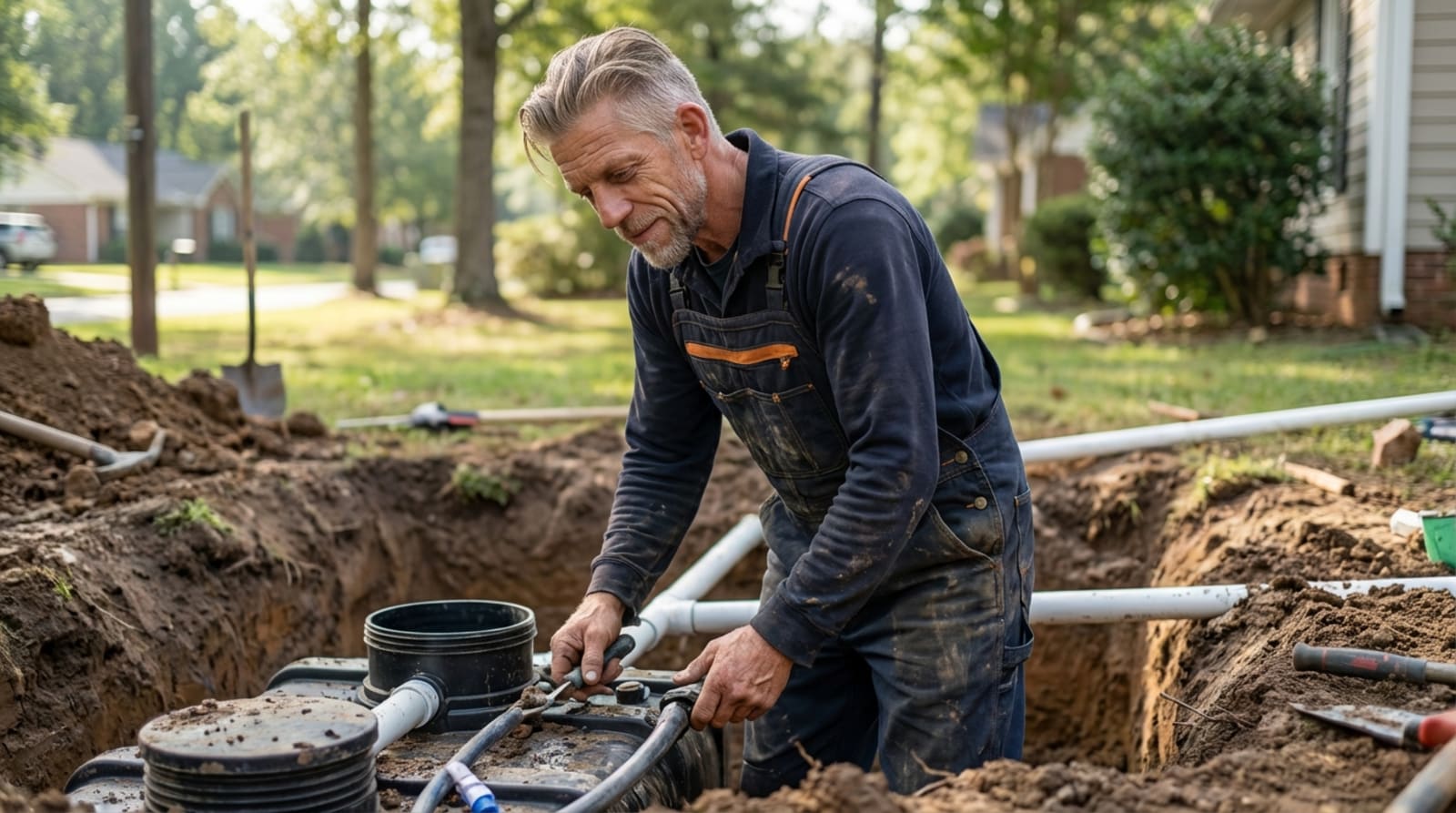
Why Professional Septic Tank Installation Matters
A septic system is one of your home’s most critical investments—and it’s invisible until something goes wrong. Poor septic tank installation leads to premature system failure, expensive repairs, sewage backups into your home, contamination of your groundwater, and drain field replacement costs that can reach $15,000 or more. Too many Chattanooga homeowners discover installation problems only after the damage is done and bills mount into the thousands.
Installation mistakes are nearly impossible to fix once buried underground. Improper tank sizing, incorrect drain field design, poor soil assessment, or missed permits create long-term problems that damage your property value, trigger health department violations, and threaten your family’s health. That’s why professional septic tank installation in Chattanooga isn’t optional—it’s the only way to protect your investment and ensure your system works reliably for decades.
Chattanooga Septic Tank brings 20+ years of experience installing septic systems for new homes, additions, and replacements across Hamilton County. We’re licensed by the Tennessee Department of Environment and Conservation (DOEC), trusted by over 2,000 families, backed by an A+ BBB rating, and committed to 100% satisfaction. When your septic system is this important, you need licensed professionals who take installation seriously.
The Septic Tank Installation Process: 6 Critical Steps
Professional septic tank installation isn’t rushed. Every project follows the same rigorous process that ensures code compliance, proper function, and longevity. Here’s what happens from start to finish:
Step 1: Site Assessment & Soil Evaluation
Installation begins by understanding your property inside and out. We evaluate:
- Lot size and available space for drain field placement
- Soil type, composition, and drainage capacity (clay, sand, silt mix)
- Seasonal water table and groundwater conditions
- Proximity to wells, property lines, and existing structures
- Access and terrain challenges
Soil percolation testing (perc test) determines how quickly water drains through your soil—critical data that determines tank and drain field sizing. Properties with clay-heavy soil (common in Chattanooga’s East Brainerd and Hixson areas) require larger drain fields and engineered design approaches than properties with sandy soil. We adapt every installation to your soil’s unique characteristics.
Step 2: System Design & Sizing
Once we understand your site, we design a system that matches your needs exactly:
- Household size and water usage projections (based on bedrooms and bathrooms)
- Number of fixtures and daily water consumption
- Seasonal occupancy or rental considerations
- Future expansion potential and growth
Tank sizing ranges from 750 gallons for small homes to 3,000+ gallons for larger families. Undersized tanks fail within years; oversized tanks waste money and space. Our design engineers hit the sweet spot for your property, ensuring optimal performance and longevity.
Step 3: Permit Applications & Health Department Coordination
Tennessee DOEC and local health department permits are non-negotiable for any septic tank installation. We handle all permitting requirements:
- Site plan preparation and submissions
- Professional system design documentation
- Soil test reports and percolation data analysis
- Health department applications and approvals
- Inspection scheduling and coordination
Navigating permit requirements takes time, expertise, and attention to detail. We ensure every document is correct, complete, and submitted on schedule—preventing delays, costly revisions, and code violations. Most homeowners never see a permit form; we manage the entire process.
Step 4: Excavation & Professional Tank Installation
With permits approved, our licensed technicians handle excavation and installation:
- Careful excavation of tank and drain field trenches
- Precise tank placement and leveling (critical for correct flow and solids settling)
- Professional inlet and outlet pipe installation with baffles
- Drain field distribution system with proper slope and spacing
- Approved bedding materials and careful backfill
Tank placement is precision work. Tanks must be level to function correctly—even a slight slope causes solids to accumulate unevenly and baffles to fail. We measure, level, and verify every installation detail. Drain field installation requires careful design and construction. We space drainage lines correctly, use proper aggregate bedding, and ensure soil contact for optimal absorption. In challenging soil (like Signal Mountain’s rocky terrain or Soddy-Daisy’s clay), we may recommend engineered systems with aeration, sand filters, or mound designs—extra investment now prevents expensive failure later.
Step 5: System Testing & Final Inspection
Before your system is live, we conduct comprehensive testing:
- Visual inspection of all components and connections
- Flow testing to verify proper drainage and distribution
- Tank integrity and baffle verification
- Drain field absorption testing under load
- Comprehensive homeowner training and documentation
We don’t sign off on any installation until everything works perfectly. Your inspection paperwork becomes part of your system’s permanent record—valuable documentation if you sell or refinance your home.
Step 6: Ongoing Support & Maintenance Guidance
Installation is just the beginning. We provide:
- Clear maintenance instructions and a homeowner guide
- Schedule for regular pumping (typically every 3-5 years)
- Guidance on water conservation and system protection
- Emergency contact information for future service needs
Professional Installation vs. DIY: Why It Matters
Some homeowners attempt DIY septic installation or hire unlicensed contractors to save upfront costs. This almost always backfires spectacularly:
- Code violations and fines: Unpermitted systems trigger health department fines, lien placeholders, and mandatory removal and reinstallation at 2x the original cost
- Rapid system failure: Improperly designed systems fail within 3-5 years instead of 25+, requiring expensive replacement
- No professional recourse: Unlicensed contractors disappear when problems arise; licensed professionals carry liability insurance and warranty their work
- Resale and refinancing problems: Most lenders and title companies require Tennessee DOEC-compliant systems; DIY work triggers appraisals, inspections, and renegotiations
Professional installation costs more upfront—typically $3,000-$7,000 for new construction and $5,000-$10,000 for replacements depending on site complexity. But it’s insurance against the $10,000-$20,000 cost of premature failure, system replacement, and property damage. Licensed installation protects your investment, your home value, and your family’s health. The peace of mind alone is worth it.
Septic Tank Installation Across Hamilton County
We install septic systems throughout Chattanooga and surrounding communities:
Chattanooga: Downtown, North Shore, Southside neighborhoods
Signal Mountain: Properties with challenging terrain and higher elevation
Hixson: Growing residential areas with varying soil conditions
East Brainerd: New construction developments and subdivisions
Soddy-Daisy: Rural properties with larger lot requirements
Lookout Mountain: Elevated properties with unique drainage patterns
If you’re in Hamilton County and need septic tank installation, call to confirm your address and service availability. Our experience includes both easy installations and complex sites with challenging terrain, soil conditions, or space constraints.
Complete Septic Solutions Beyond Installation
Septic tank installation is the foundation, but we provide complete septic system services:
- Septic Tank Replacement when repairs aren’t cost-effective
- Permit Assistance for complex projects and special circumstances
- System Design Consultation for unique properties and challenging sites
- New Construction Septic Systems for developments and subdivisions
- Our Services include inspection, pumping, maintenance, and repair
Explore Our Service Areas or browse Our FAQ for answers to common questions about septic tank installation, maintenance, and costs.
Why Chattanooga Families Trust Us for Septic Tank Installation
- Licensed Tennessee DOEC: All installations meet rigorous state sanitation standards and codes
- A+ BBB Rating: Consistent positive reviews, no unresolved complaints, and verified customer satisfaction
- 2,000+ Families Served: Two decades of professional installations across Hamilton County
- 100% Satisfaction Guarantee: If you’re not happy with your installation, we make it right
- Same-Day/Next-Day Emergency Response: Urgent issues handled promptly to minimize disruption
- Transparent, Honest Pricing: No hidden fees, no upsells, no pressure—just honest estimates and fair pricing
Your septic system is too important for guesswork or unlicensed contractors. Call Chattanooga Septic Tank today for professional installation you can trust.